



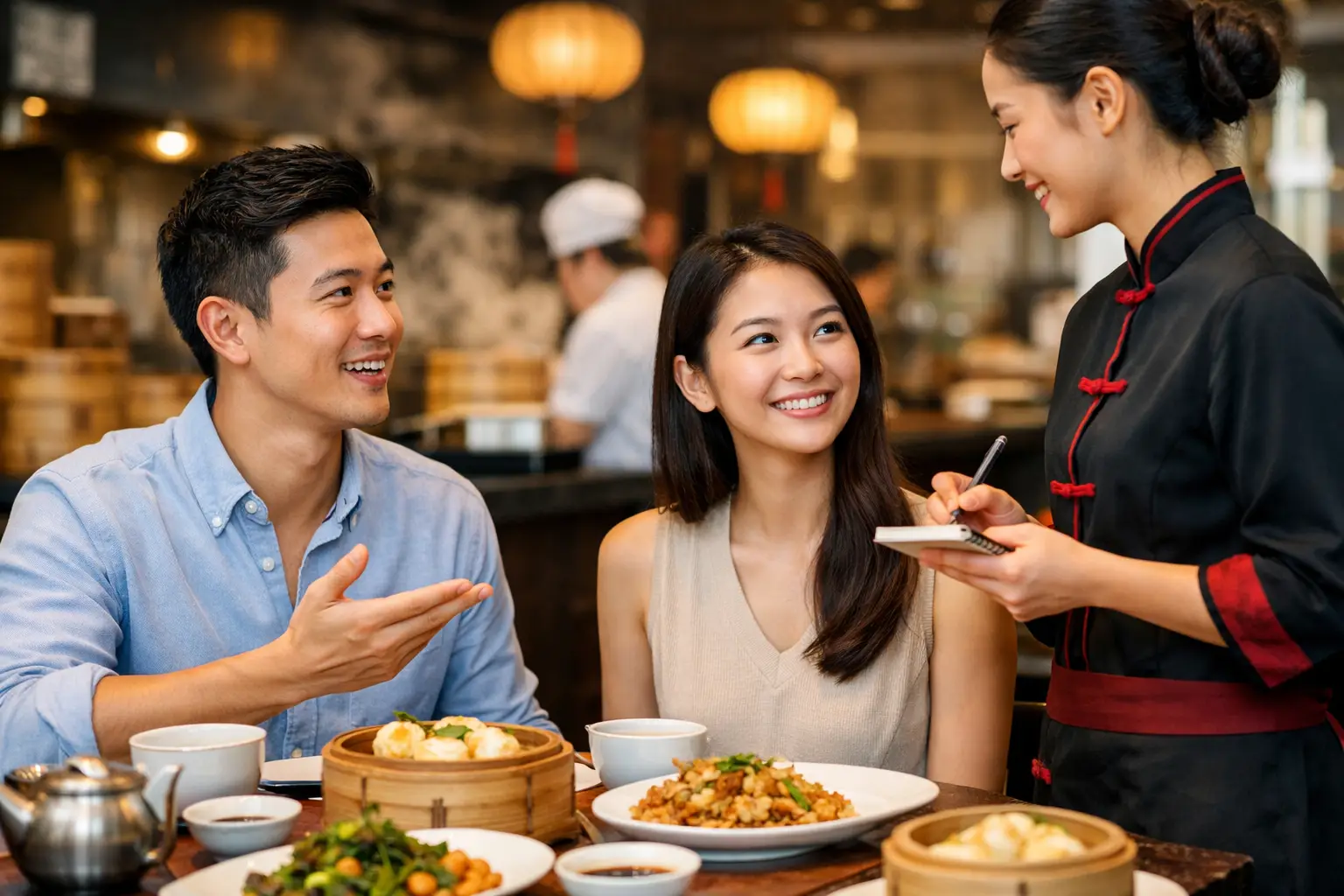
The first time a server asks a quick question in Cantonese while the line moves behind you, even a simple lunch order can feel like a language test. Learning how to order food in Cantonese changes that experience. A few high-use phrases help you ask for what you want, understand the most common replies, and enjoy more of Hong Kong’s restaurants, cafés, cha chaan tengs, and market stalls with confidence.
You do not need perfect tones or a large vocabulary to begin. What matters is having practical language ready for the moments that happen at the counter: choosing a dish, changing an ingredient, saying whether you are eating in, and paying the bill.
Start With the Cantonese Politeness That Opens Doors
Cantonese ordering is often fast, especially during lunch hours, but it is not unfriendly. A polite greeting and a clear request go a long way.
Start with nei5 hou2 (你好), meaning “hello.” For “thank you,” use m4 goi1 (唔該). You will hear it constantly in restaurants because it is used when thanking someone for a service, handing over payment, or getting a menu.
When you are ready to ask for something, ngo5 soeng2 jiu3… (我想要…) means “I would like…” It is a comfortable, courteous phrase for beginners. For example, ngo5 soeng2 jiu3 ni1 go3 (我想要呢個) means “I would like this one.” Pointing to a menu item while saying it is completely acceptable.
You may also hear local diners say ngo5 jiu3… (我要…), or “I want…” This is direct but normal in casual food settings. If you are building confidence, begin with ngo5 soeng2 jiu3 and gradually adopt the shorter version as it feels natural.
How to Order Food in Cantonese Step by Step
A reliable order follows a simple pattern: greet the staff, state the item, add any changes, then confirm whether it is for here or to go. You can handle many everyday situations with just a few flexible phrases.
Choose your dish
Use ni1 go3 (呢個) for “this one” and go2 go3 (嗰個) for “that one.” These words are especially useful when menus have Chinese characters you cannot yet read.
Try these practical sentences:
Ngo5 soeng2 jiu3 ni1 go3. (我想要呢個。) – I would like this one.
Ngo5 soeng2 jiu3 jat1 go3… (我想要一個…) – I would like one…
Ngo5 soeng2 jiu3 loeng5 go3… (我想要兩個…) – I would like two…
Jau5 mou5… ? (有冇…?) – Do you have…?
If you are looking for a specific item, such as milk tea, say jau5 mou5 naai5 caa4? (有冇奶茶?). You do not have to make every sentence long. A clear key word, friendly tone, and a gesture toward the menu are often enough.
Ask for changes without guessing
Customizing food is where learners often freeze, yet the vocabulary is wonderfully reusable. M4 jiu3 (唔要) means “do not want” or “no,” while siu2 (少) means “less.”
For common requests, use m4 jiu3 jat1 go3… to say you do not want an ingredient, or simply point and say m4 jiu3 ni1 go3 – “not this.” If you want less ice, say siu2 bing1 (少冰). For less sugar, say siu2 tim4 (少甜).
Spice is another useful category. Siu2 laat6 (少辣) means mildly spicy or less spicy, gaa1 laat6 (加辣) means add spice, and zau2 laat6 (走辣) means no spice. The word zau2 generally means to leave something out, so you may see it used for other menu modifications as well.
If your dietary needs are serious, keep your request short and make sure it is understood. For example, ngo5 m4 sik6 juk6 (我唔食肉) means “I do not eat meat.” For allergies, do not rely only on a brief phrase or assume a dish can be made safely. Ask staff directly, repeat your concern, and choose the setting carefully. Small stalls may have less control over cross-contact than a restaurant that can discuss ingredients in detail.
Eat in or take it away
At many counters, staff will ask whether your order is for dining in or takeaway. Tong4 sik6 (堂食) means “eat in,” while ngoi6 maai6 (外賣) means “takeaway.”
If you want to state it first, say tong4 sik6, m4 goi1 for “eating in, please,” or ngoi6 maai6, m4 goi1 for “takeaway, please.” You may also hear daa2 baau1 (打包), which means to pack food up. It is useful when you want to take leftovers home.
Understand the Questions You Are Most Likely to Hear
The goal is not to understand every conversation around you. Focus first on recognizing the questions that affect your order.
Sik6 mat1? (食乜?) means “What would you like to eat?” The final word, mat1, means “what.”
Jam2 mat1? (飲乜?) means “What would you like to drink?”
Jiu3 m4 jiu3… ? (要唔要…?) means “Would you like…?” Staff may ask this about a drink, a set meal, or an add-on. If you do not want it, m4 jiu3, m4 goi1 is a polite response.
Gei2 do1 cin2? (幾多錢?) means “How much is it?” This is useful at markets and casual stalls, although many restaurants present the bill automatically.
When you want the check, say maai4 daan1, m4 goi1 (埋單,唔該). Literally, it refers to settling the bill, and it is the standard phrase to use at a table-service restaurant.
Numbers are helpful, but do not let them stop you from ordering. You can begin by pointing to the quantity on a menu or holding up fingers when appropriate. As you learn Cantonese, numbers become one of the most rewarding early skills because they help with prices, table numbers, and portions.
Match Your Language to the Restaurant
Food ordering in Cantonese depends on the setting. At a busy cha chaan teng, a short order is often best: name the dish, name the drink, and make changes clearly. A server may expect you to order quickly, but there is no need to panic. A calm m4 goi1, ngo5 tai2 haa5 sin1 (唔該,我睇吓先) means “Please, let me look first.”
At a dim sum restaurant, you may order by marking a card, scanning a QR menu, or speaking to staff. Learning dish names can be useful, but the immediate advantage comes from knowing quantities and pointing confidently. In a neighborhood market or food stall, the menu may change daily, so jau5 mou5…? is particularly valuable.
More formal restaurants may have English-speaking staff and bilingual menus. Using Cantonese is still worthwhile, not as a performance, but as a practical way to connect and handle small interactions independently. Switch to English when accuracy matters or when the conversation becomes too complex. Real communication is the goal, not proving that you can complete every exchange in one language.
Build Confidence Beyond the Phrasebook
Pronunciation matters in Cantonese because tones can change meaning, but perfection is not the entry requirement. Listen for rhythm, practice short phrases aloud, and learn chunks you will genuinely use. It is easier to remember ngo5 soeng2 jiu3 ni1 go3 after saying it at lunch than to memorize isolated vocabulary at home.
A productive practice routine is to choose one food situation each week. First, practice ordering a drink. Next, add a request such as less ice or no spice. Then practice answering “eat in or takeaway?” Rehearsing a complete mini-conversation prepares you for the speed of a real counter better than studying a long word list.
For professionals, expatriates, and families who want faster progress, structured speaking practice can make these everyday exchanges feel natural. A practical Cantonese course at International Language Centre can help learners build food, transport, workplace, and social vocabulary around the situations they face most often.
Your next order does not need to be ambitious. Choose one phrase, use it with a smile, and let the interaction be a small win. Each successful request makes the next conversation easier – and gives you a more personal way to experience the city around you.